
The Central Albany Revitalization Area (CARA) was established in 2001 to address blight and neglect in the city’s historic downtown area and the surrounding neighborhoods. This tax increment financing district essentially froze property tax receipts at then-current levels for the area for all taxing agencies, such as the City of Albany, with increases in property taxes beyond those levels then going to fund the Albany Revitalization Agency (ARA), tasked with allocating funds to projects that will provide permanent improvements and spur new investment and economic activity within the area.
The program has been successful in revitalizing downtown and the surrounding areas, including three of the city’s historic districts. According to the City’s website, every dollar spent by the agency has attracted an additional six dollars of private investment in the area, an excellent return on investment for public funds. This distribution of grant and loan funds to local businesses has funded over 100 projects in the city’s historic core, as outlined on the city’s Urban Renewal Projects page, which also features a great GIS map of project locations and details:
Web map of prior CARA Urban Renewal Projects linked from the City of Albany Map Gallery. Map Credit: City of Albany GIS. (City of Albany – Map Gallery)
CARA’s time serving the city of Albany is coming to a close. Once a tax increment financing district reaches “maximum indebtedness,” defined at its establishment, it must pay off its remaining debt and wind down. “Maximum indebtedness” is essentially a total borrowing limit for the agency, regardless of how much has been paid back over time (it’s not a measure of how much the agency actually owes). CARA will reach its maximum indebtedness within the next year, and has been tasked with determining how remaining agency funds will be spent before closure.
The first project that the ARA board took on, was to allocate 50% of remaining funds ($545,000) to Pacific Power’s undergrounding project along Water Avenue in order to offset these costs and prevent them from falling solely on the shoulders of ratepayers at a time when electricity rates are already seeing historic year-over-year increases.
The remaining $545,000 were designated for a “last round” of the CARA business grant program, whereby local businesses may apply for funds for renewal related projects. This mirrored the prior CARA grant program as much as possible.
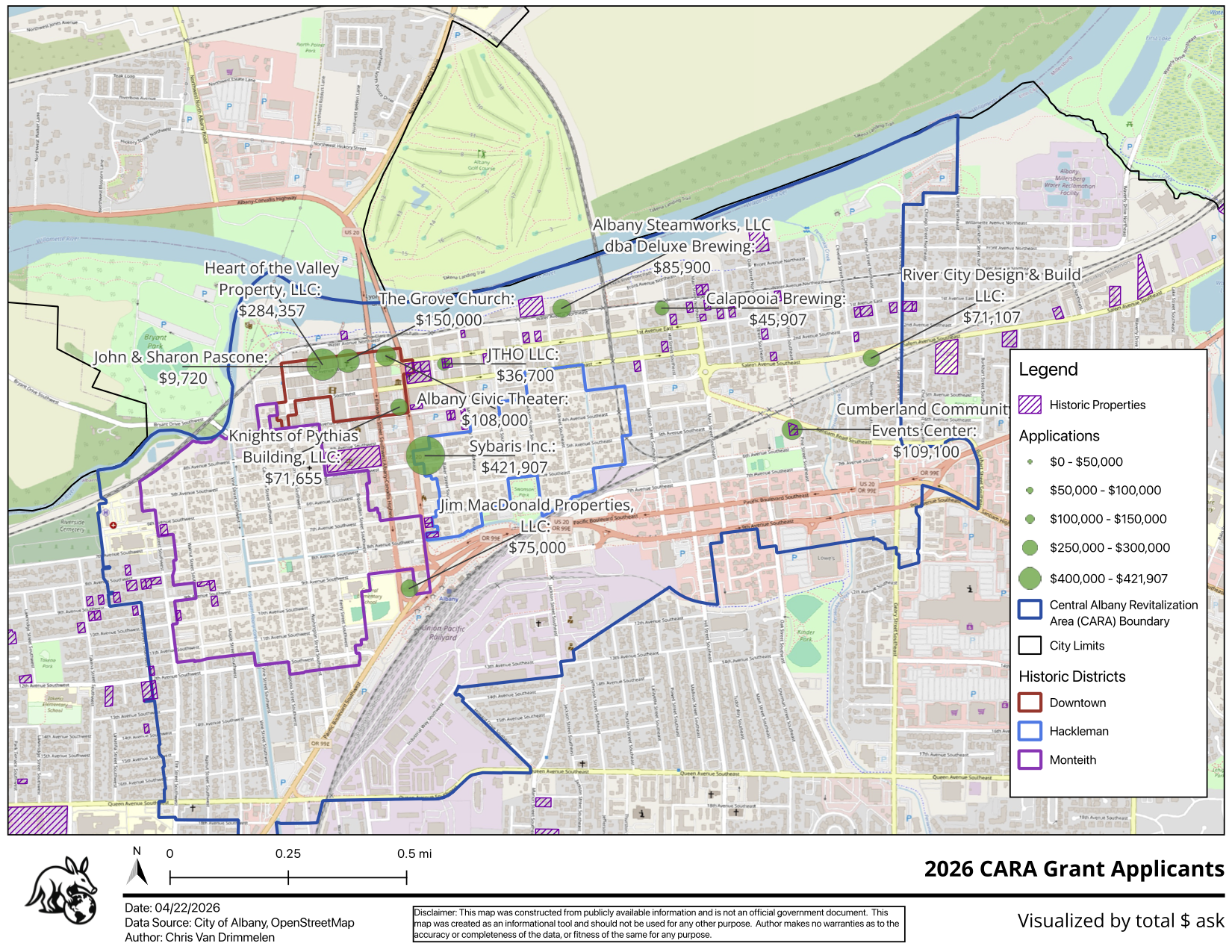
12 applicants submitted complete applications as detailed in the April 22 ARA agenda packet. All of the project, big and small, have something to recommend them, but the total ask is over $1,400,000, almost three times the amount of money ARA actually has to award, so decisions have to be made. The application materials from each applicant were informative, but even the overall summary materials lacked a sense of where the projects would take place within geographic context. So I made a map:
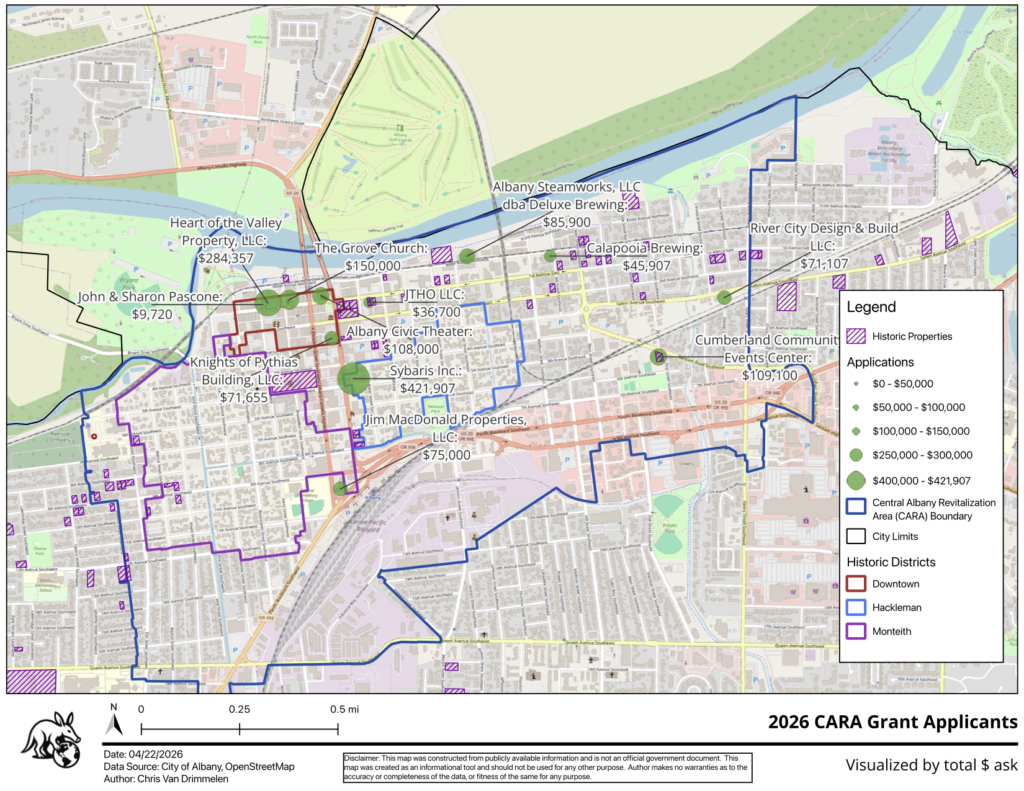
Using the city’s hosted layers for the CARA boundary and historic districts (as historic preservation is a key goal of CARA), I have geocoded the addresses of the projects from the application documents and varied the point symbology for the dataset by total financial ask (larger dots equal a larger funding request). I also layered the city’s hosted Historic Properties layer on top of the other datasets, as not all properties within a historic district are designated as “historically contributing,” and historic buildings can also occur outside of historic district boundaries, so it may be of interest.
I also ran up a quick interactive visualizer using QGIS and Leaflet that can be explored above. Symbology is largely the same (mouse over the layers icon in the upper right to see legend and layers that you can turn on and off), and now one can click on any of the projects to see additional detail, such as component elements of each project as stated in each applicant’s submitted materials.
On April 22nd, the ARA Board (which also happens to be the members of the City Council), met and heard from representatives from all 12 projects. With only two hours in which to meet, this did not leave a lot of time for discussion. The only decision made before the group ran out of time was to award Sybaris Bistro $261,940, a partial award to offset costs for Phase 2 of the restaurant’s restoration of the old Oregon Electric Railroad depot as their new location, leaving $283,060 to be allocated at the May 27th ARA Board meeting.
One ARA board member has already stated that they would like to give priority to projects in the Hackleman district if possible, as much attention has already been paid to downtown and Montieth, so perhaps the spatial distribution of the requests and the question of “where” will play an important role in the process.