
The use of Automated License Plate Reader (ALPR) cameras has featured prominently in the news in recent months, particularly throughout the Willamette Valley as several cities have terminated their contracts with Flock Safety over concerns about data being shared with federal immigration authorities, allegations of unauthorized use of the cameras, and privacy concerns from citizens. Flock, while possibly the most well known vendor of ALPR cameras, to the point where such technology is sometimes broadly referred to as “Flock Cameras,” regardless of the actual manufacturer or vendor, sells a service whereby automated cameras record the license plate and vehicle characteristics of passing cars that can then be queried by law enforcement agencies who are customers of Flock, allowing police to know if a particular vehicle (or one closely matching a description) has been present at a particular point and when. Vehicle plates and descriptions connected to a suspected crime can also be placed on a “hot list,” thus that if the vehicle in question passes an ALPR reader, the law enforcement agency that placed it on a list will receive a notification of the suspect vehicle’s location.
ALPR technology can also be used from mobile platforms such as mounted on a patrol vehicle, or for non-law-enforcement uses such as access control or parking enforcement.
Albany, Oregon suspended its use of Flock ALPR cameras in April of 2026 over concerns brought forward by the Oregon Law Center that Oregon agencies’ data had been accessed via the Flock system by federal immigration authorities. Making such local law enforcement data available for immigration enforcement would run afoul of Oregon’s Sanctuary Law, which prohibits the use of state or local law enforcement resources for immigration enforcement purposes when the only suspected violation is being in the country illegally. Prior to the shutdown, Albany only had one functioning Flock ALPR camera, located at 1st Ave and Ellsworth Street in Downtown Albany. The cameras are designed to read only the read license plate of each vehicle, and this camera was pointed “into” town, thus capturing images of vehicles entering Albany from Benton County. Three other sites were identified for camera placement in line with a grant that the city received to purchase the system from the Oregon Criminal Justice Commission to combat organized retail theft:
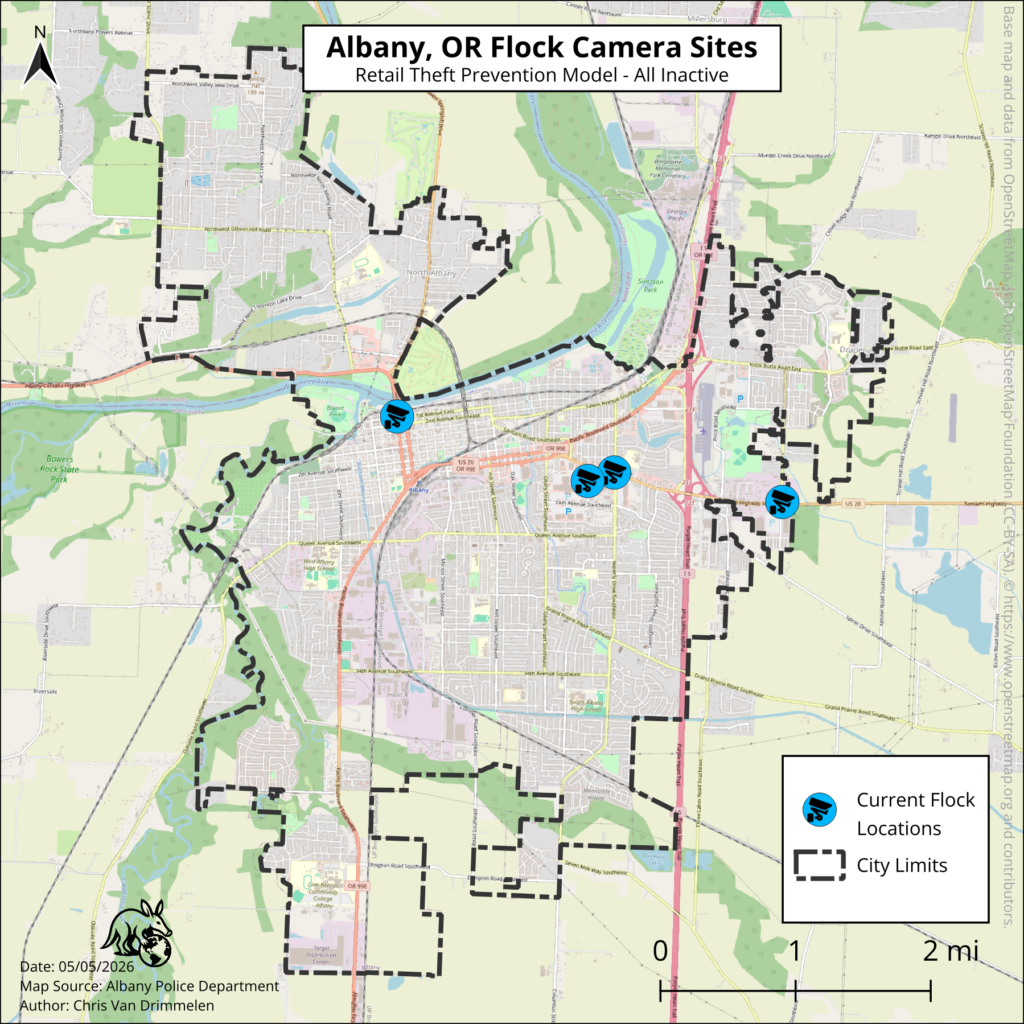
In line with the intent of the grant program, one can see on the map above that the camera locations were chosen near large retailers such as WalMart, Fred Meyer, Target, and in the downtown retail core of Albany. It is worth noting that none of these locations have a camera, active or not, as of this writing, as the only functional camera remaining as of the shutdown at 1st and Ellsworth has been, itself, stolen.
Since that time, the Albany City Council has heard from the Albany Police Department, the Oregon Law Center, and a representative from Flock Safety about the relative merits of ALPR cameras as a law enforcement tool, and more details about concerns over data sharing, whether intentional or unintentional, with federal immigration enforcement agencies. In late 2025, Flock placed all Oregon law enforcement agencies in a “contained environment,” where, according to Flock, data can only be accessed by other Oregon agencies. The potential privacy implications of such systems have also been once again brought to the fore, particularly the question of what level of surveillance should citizens tolerate in the name of public safety.
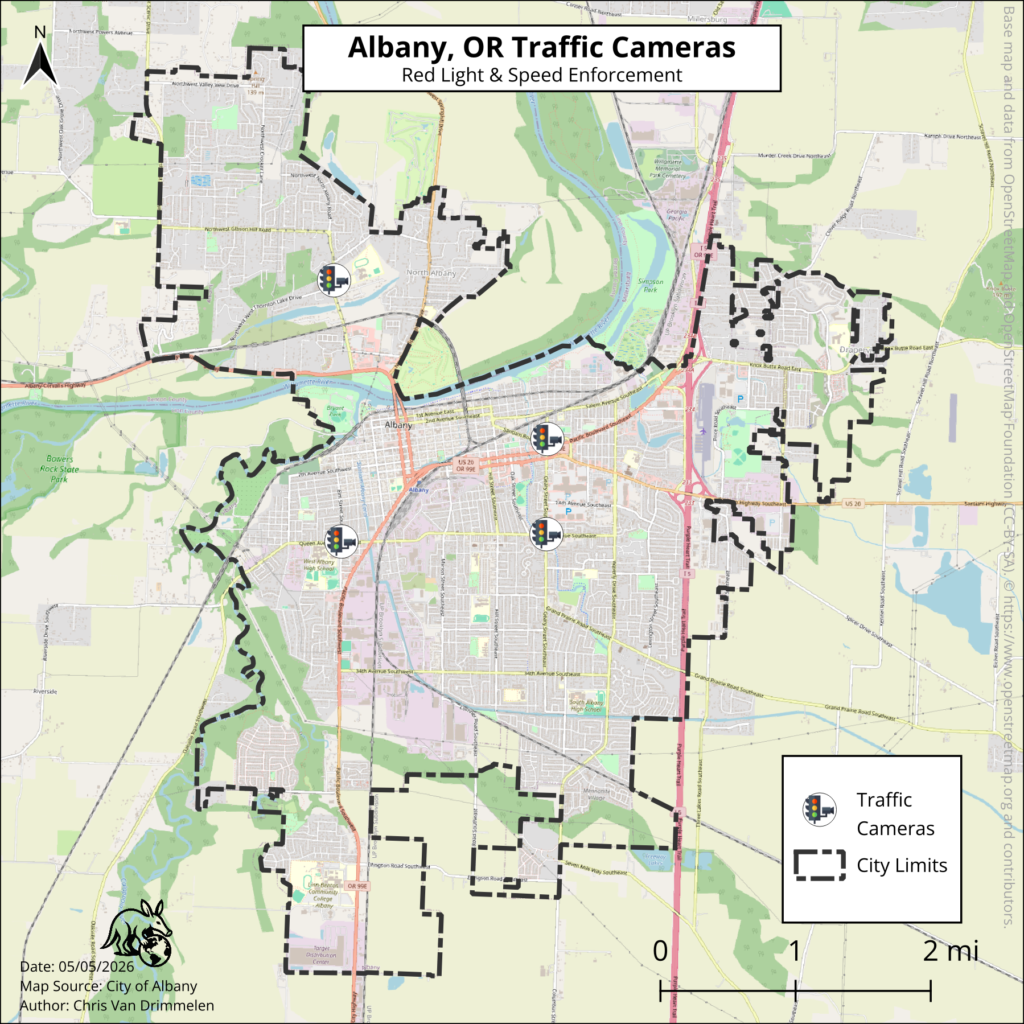
It is important to note that Albany’s use of ALPR cameras is NOT the same as its photo-traffic-enforcement cameras, as illustrated in the below map. These cameras are at four completely different locations, and capture images of vehicles that either run a red light or pass through the intersection at at least 11 miles per hour over the speed limit so that a citation can be issued to the driver for violation of traffic laws.
In either case, photo enforcement or ALPR, Albany Police policy treats the input from the camera as a “tip,” requiring review and follow up by a sworn officer before any action is taken. No automatic tickets are written in the case of photo enforcement, and no automatic bulletins or other actions are created by the ALPR system.
Flock and other ALPR readers are not only available to public agencies. Private entities can also purchase their own systems as well, which feed into the larger plate and description database. According to the organization DeFlock, an advocacy organization which crowdsources information about surveillance technology and advocates for the discontinuation of technologies like ALPR, there is one private operator of an ALPR system in Albany – Lowe’s, with three cameras on their property, likely with the intent of deterring and/or prosecuting retail theft:
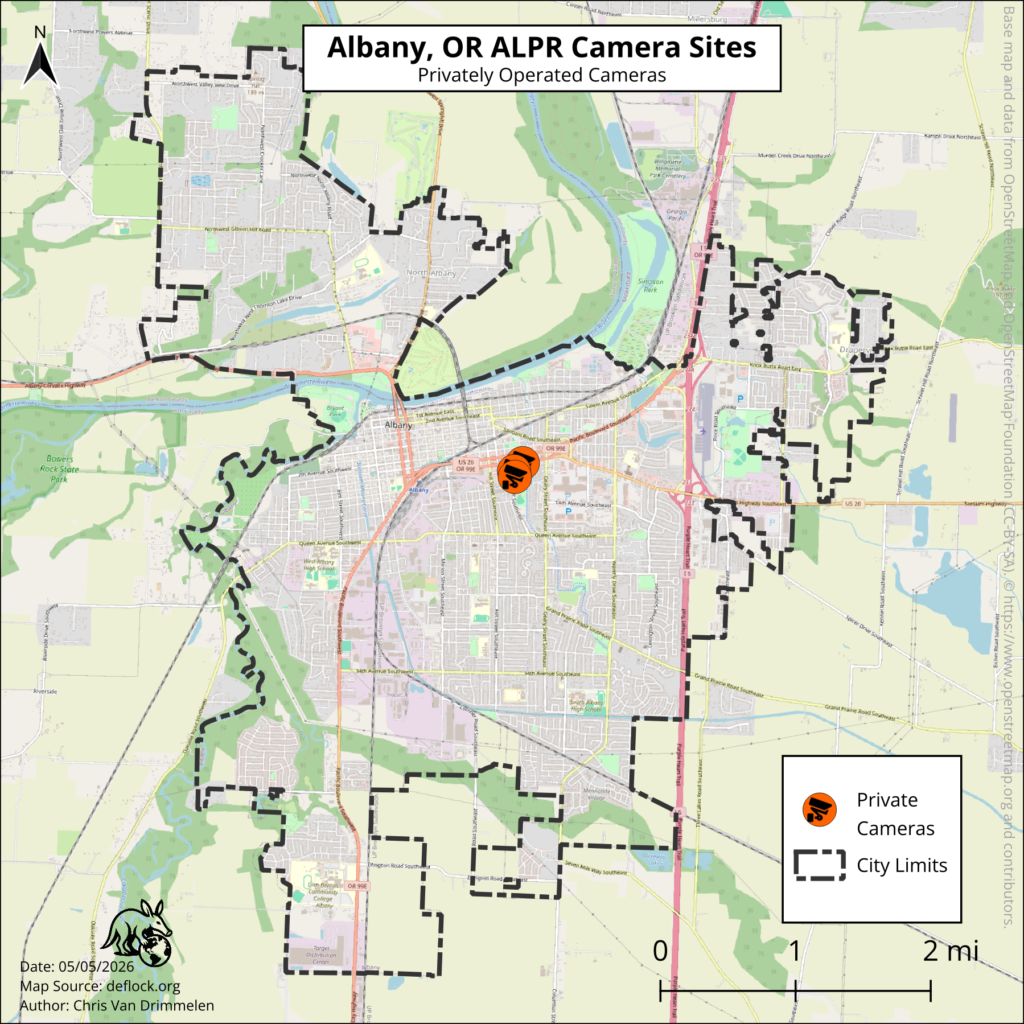
The nature of the crowdsourced points from DeFlock should be treated as neither comprehensive nor authoritative, as other private ALPR systems may exist but not have been reported, however it does serve to illustrate that governmental use of ALPR cameras, and any restrictions on them imposed by city code or state statute are only one piece of the actual policy discussion. While Albany does not currently regulate private use of ALPR systems, it theoretically could, in a similar manner to how the city decided to regulate where cryptocurrency kiosks can and cannot operate within the city limits in 2025.
Apart from concerns about state law and data sharing with federal immigration enforcement, one of the major arguments against ALPR camera systems like Flock being deployed broadly is the notion that such data could be used to build a “profile” on an individual, including information about where they live, work, shop, and more based on where their vehicle shows up in an ALPR database. As with any technology, there is also potential for abuse, including cases where officers are alleged to have misused camera data to target or keep tabs on individuals not suspected of crimes (none of these allegations have come out of Albany, to be clear).
At the same time, law enforcement agencies, including the Albany Police Department, maintain that ALPR technology is an invaluable tool in modern policing that enables fast queries to see if a vehicle associated with a crime, such as theft, kidnapping, or worse is in an area, and can also help establish timelines in investigations and accidents. The same debate has been going on in Bend, Oregon, with the Bend Police Department highlighting multiple success stories tied to their ALPR readers, including the ability to apprehend individuals attempting to flee after a crime, and the ability to locate non-local suspects who have traveled to or through their jurisdiction. These successes would have relied on manual efforts by officers and a large measure of “good luck” for an officer to be in the right place at the right time without ALPR technology.
So is there a way to mitigate some of the privacy concerns over ALPR cameras? It is not possible to completely prevent the misuse of any system by bad actors, and use of a proprietary system like Flock requires some degree of faith in the company itself that their system and access to the data functions they way that they say it does, as there is not an effective way to hold them accountable if it does not other than to cancel the contract and discontinue its use. These concerns deal largely with risk tolerance and will be a conversation that balances benefits vs. drawbacks, but there is an element to this debate where geography may play a role in mitigation.
In conversations at City Council meetings, APD has agreed that one of the most useful aspects of this system is the ability to know quickly if a suspect vehicle has entered the community. Depending on the orientation of cameras, it may also be possible to know if a suspect vehicle has left Albany. Given this, and the ongoing concern about “profiling,” it may make sense to limit the city’s use of ALPR to locations that would provide entry/exit data rather than information about how vehicles move about within Albany. So what could that look like?
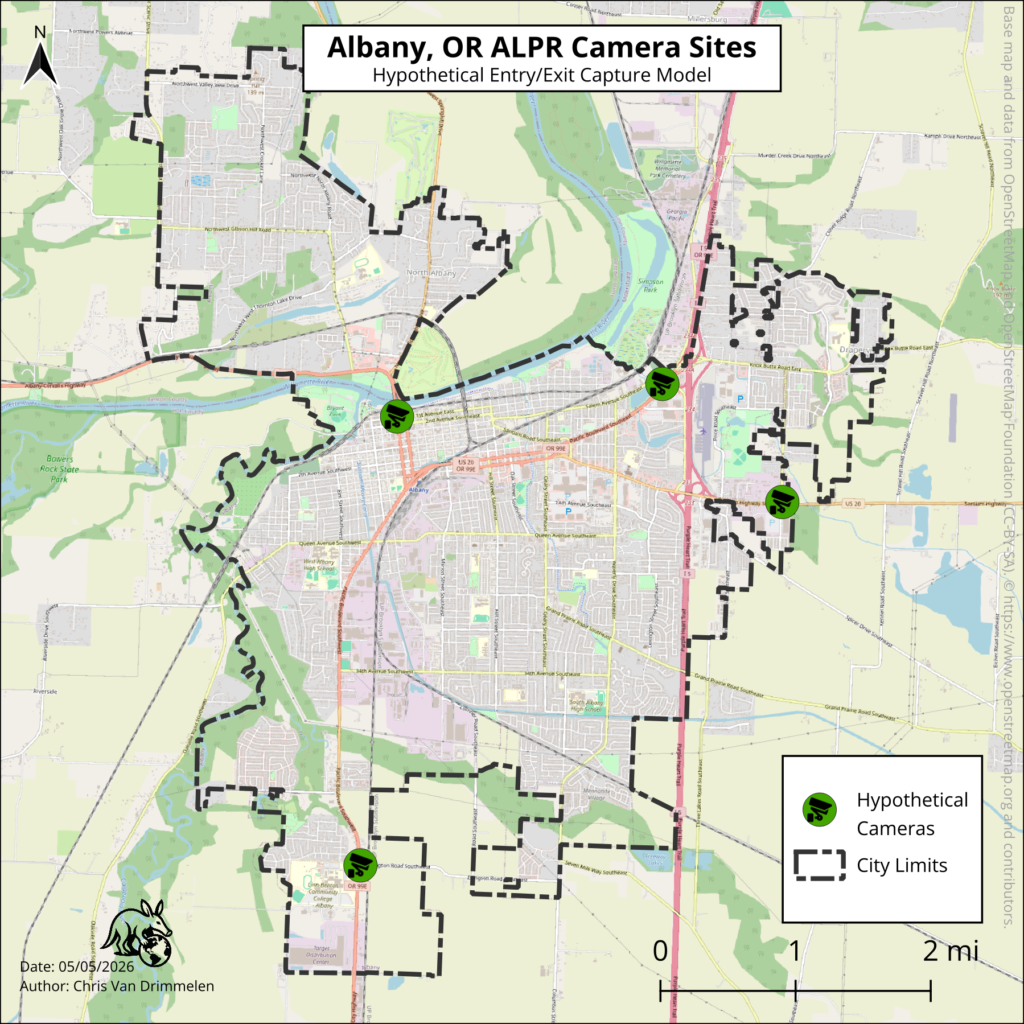
One hypothetical scenario is presented above, maintaining the same number of cameras, but at different locations. Bear in mind that this is speculative in nature based on geography, and does not represent any actual decision, policy, or action on behalf of the city.
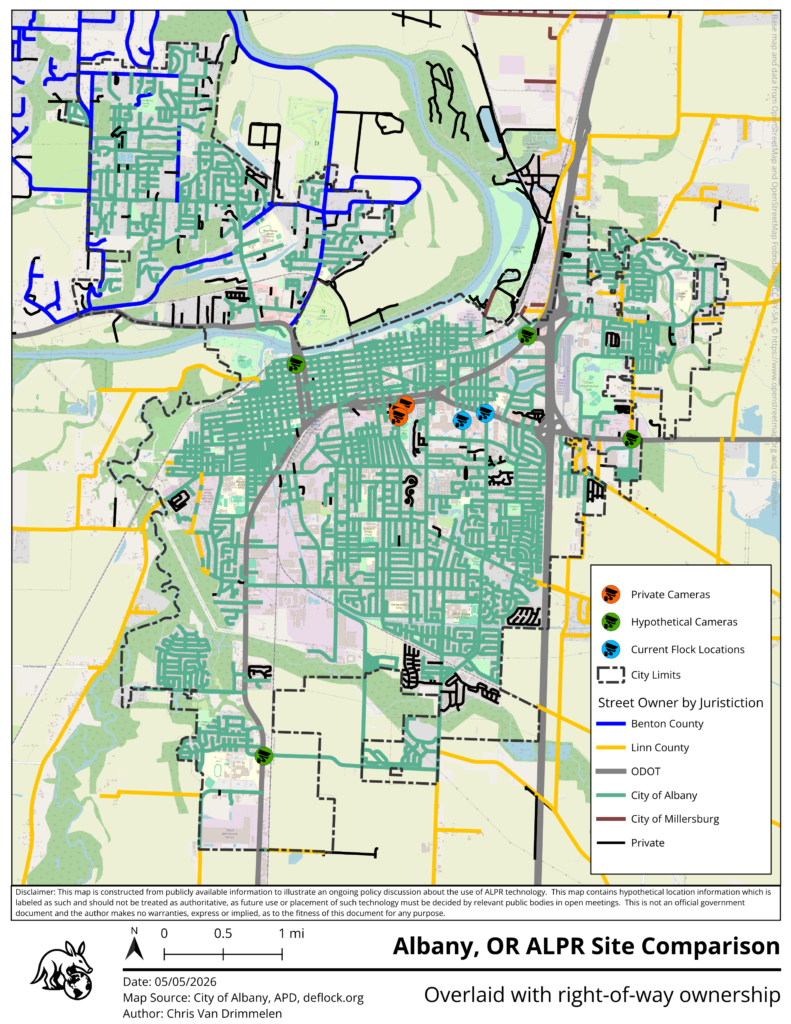
The above scenario maintains two of the “current” four locations – 1st & Ellsworth, and on Highway 20 near WalMart as these locations already capture a location near the edge of the city. While the downtown camera captures vehicles entering from Benton County across the Ellsworth Street Bridge, its position on its face seems more “central” than at the city limits, however it is important to note that the City is not allowed to place cameras outside of its own right-of-way. Highway 20 in North Albany is owned by ODOT, and most of the other roads leading in/out of town along the highway are Benton County roads, so there are few plausible candidates until one crosses the river. North Albany along the highway is also heavily canopied by trees, and Flock’s cameras require good solar exposure to maintain their battery charge.
The third hypothetical location would capture entires to town from the north coming off of I-5 onto Pacific Boulevard. Placement could be accomplished on city property at Waverly Lake Park. The final camera could be placed along Pacific Boulevard on the south end of Albany where it intersects with Ellingson Road. The camera would have to be placed in the intersecting right-of-way, or would require an agreement with a private landowner along the highway, but is otherwise technically feasible in this location.
As one member of the Albany Public Safety Commission noted, this type of arrangement would preserve the most valuable aspects of the tool for law enforcement uses, while cutting out the ability to surveil or profile Albany residents as they circulate throughout the city.
Finally for comparison, a map showing all three point layers: “current” ALPR camera locations, private ALPR cameras, and the hypothetical camera locations for an entry/exit capture model, along with a layer showing the right-of-way ownership for roads in and around the city to illustrate where placement is and is not possible based on jurisdiction:
The City Council will revisit this issue in June to make a decision about whether or not to turn the cameras back on.