
Recently, the Albany City Council took up the issue of sanitary sewer connection where residents are required to transition off of an existing septic system in favor of connection to the city’s sewer system. Generally speaking, the sewer is a topic that most residents either prefer not to think about, or can comfortably put out of mind when things are working correctly. You flush the toilet, water goes down your shower drain, etc., and you don’t have to think about it as the wastewater flows to either the city sewer or your septic system. But what happens if you get caught in the middle of those two types of system?
When a property is annexed into the city limits, there are a whole host of benefits that also come with new requirements and regulations to match. The most obvious benefit of living within the city limits is the ability to connect to Albany’s municipal water and sewer systems. Unincorporated properties must often drill and maintain their own wells and/or septic systems, which are not cheap to install or maintain. The cost of such self contained systems is also borne entirely by the property owner versus being a shared expense/service to a community. For some, that independence a plus, but for many, an unexpected $15,000+ septic replacement or a costly well repair is a financial burden that they’d rather avoid even the possibility of. Failed septic systems in particular can also cause a public health hazard, leaking waste into groundwater, so sanitary sewer and wastewater treatment systems also serve an important function in cities, where greater population density is allowed versus unincorporated areas, centralizing this function as a public benefit.
Accordingly, in the city of Albany, Oregon, any property with a residence or other occupable building within 300 feet of a sewer main must connect to the system. If the property has an existing septic system in place predating annexation that is in good working order, this arrangement may remain until such time as the system begins to fail. At that point, replacement of the septic system is not allowed and the owner must construct a sewer lateral to connect to the nearby main, in addition to paying connection and system development charges for said sewer system, much like a newly constructed building adjacent to a city sewer line must do.
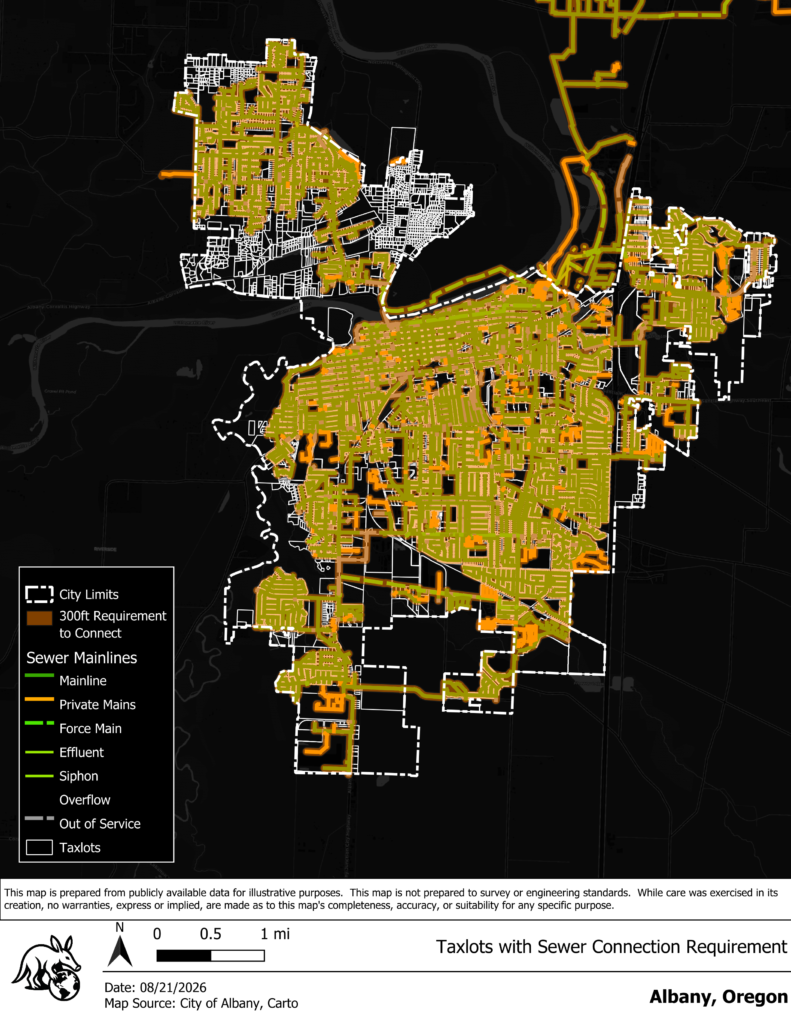
Below is a map of the Albany sanitary sewer system, created using the City’s publicly available utility layers. Note that the system also extends North to Millersburg, as the two cities jointly operate the Albany-Millersburg Wastewater Treatment Facility, located right on the border between the two, near Simpson Park and Talking Water Gardens.
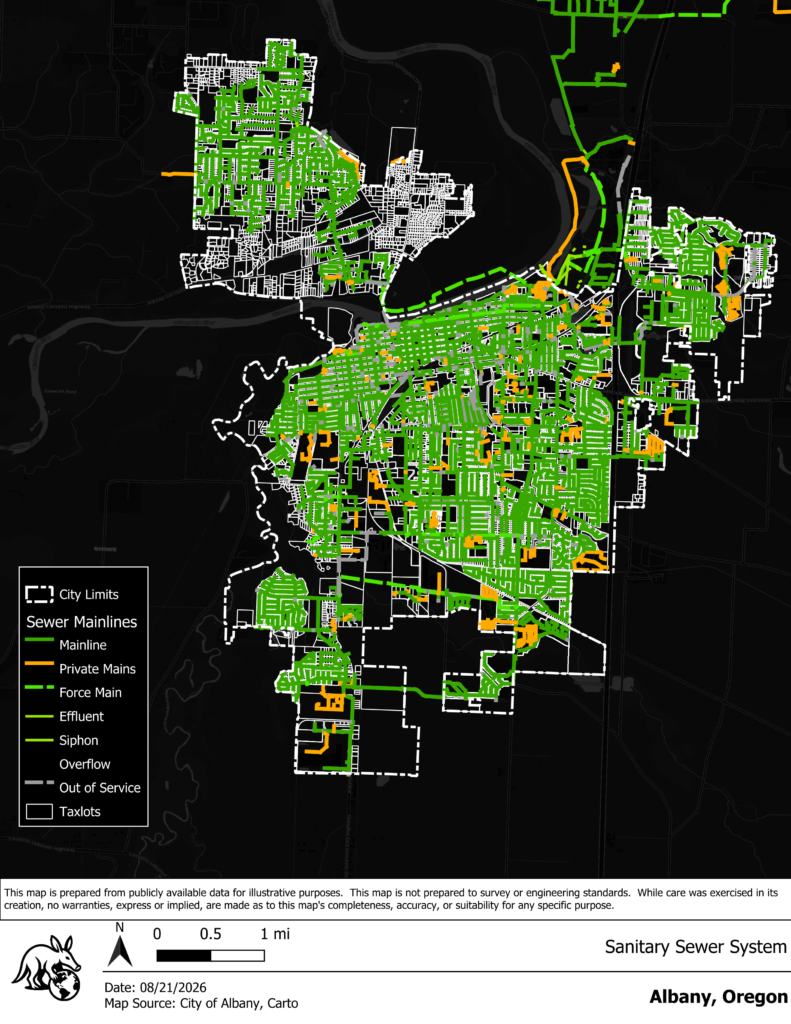
Upon first glance, the system looks pretty comprehensive. The vast majority of city streets have sewer mains running down them, to which homes and business are connected. There are a few areas, however, where a lack of sewer mains are immediately obvious, chiefly three sizable areas in North Albany.
It’s possible to at least roughly determine which properties are currently served by the sanitary sewer system using the city’s Sewer Laterals layer. A lateral is simply the pipe connecting a home or business to a main, so if a property has an associated lateral, it’s a good bet that it’s connected:
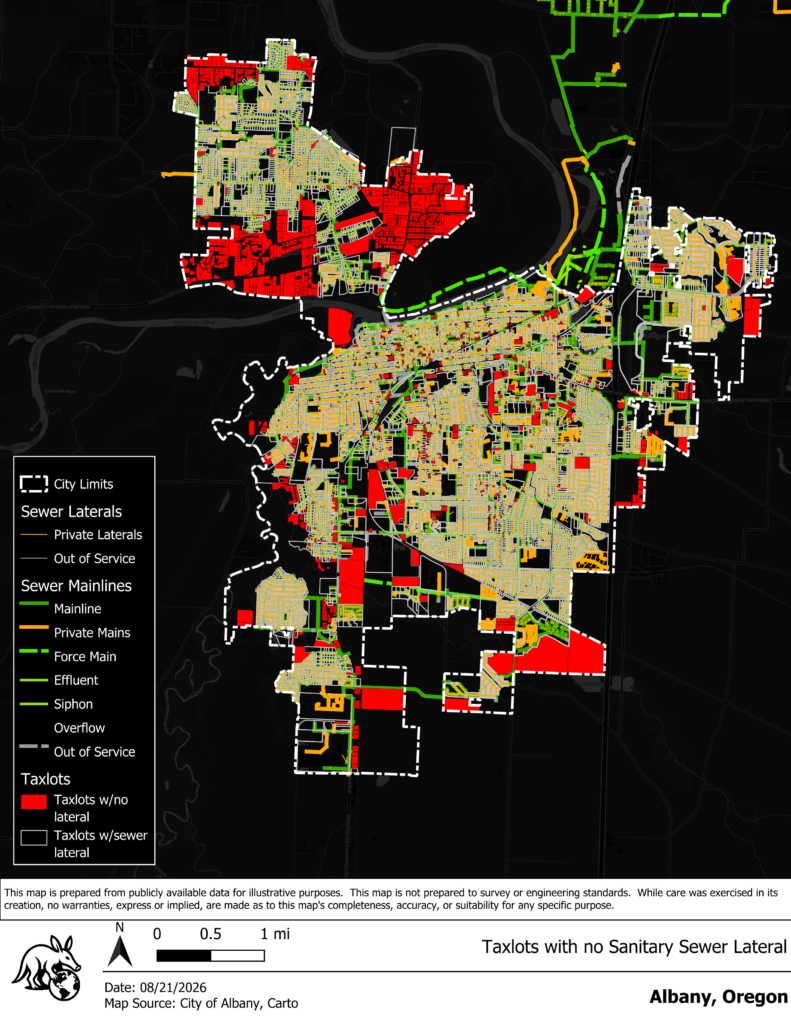
The above map joins the laterals layer to their associated tablets, and is then symbolized based on whether or not a property has a sewer lateral. Properties in red have no lateral, so are assumed to be unconnected. It’s important to note a couple of caveats:
1. Not every red property is un-served by city sewer – several of the larger industrial properties in South Albany have private sewer mains running underneath. These industrial facilities likely have direct connections to said main pipes, making a smaller lateral unnecessary, which is logical for industrial users who need a larger connection.
2. Not every red property being unserved is problematic. Upon drilling down and checking agains aerial imagery, I found that many small properties without a lateral throughout the city were undeveloped or open-space parcels: vacant lots, parking lots, or portions of city parks that span multiple lots and where the lot in question has no facilities. An undeveloped parcel has no need of a sewer connection, so no lateral is not automatically “bad.”
Where this looks the most problematic, however, is in the areas of North Albany that were previously mentioned. These predominantly residential areas do not currently have city sewer mains to connect to, so residents must rely on septic tanks to dispose of wastewater.
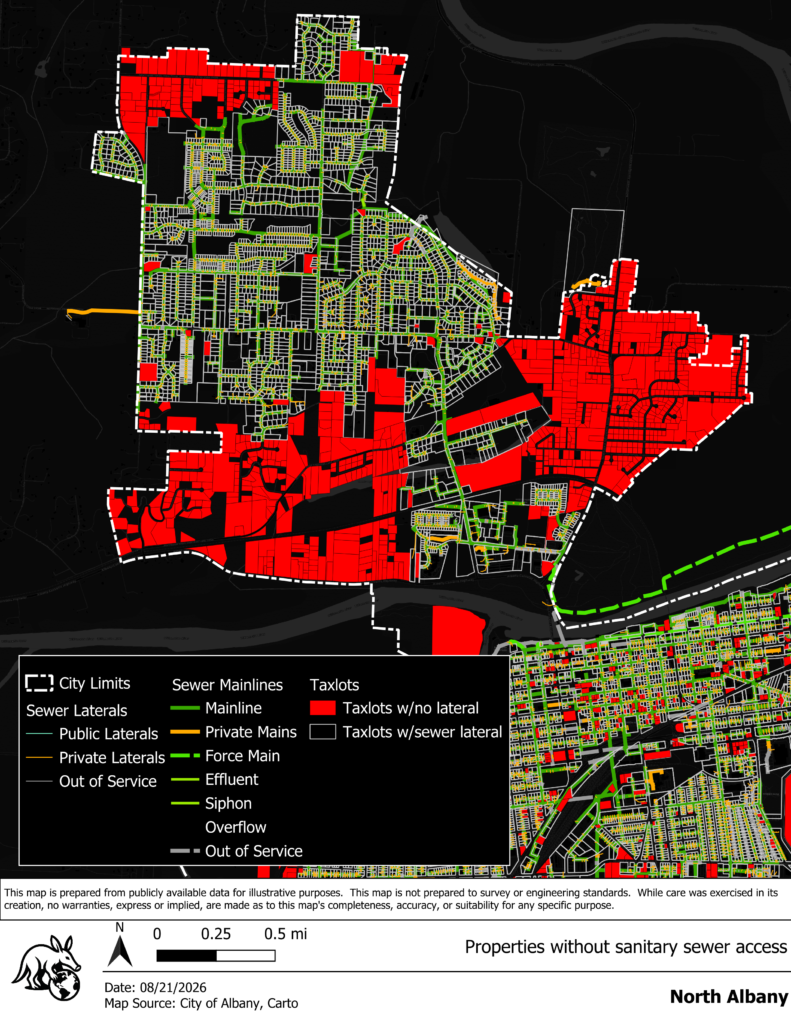
North Albany and the sewer system have a history. In 1990, the state’s Environmental Quality Commission declared a public health hazard in North Albany, which was at the time unincorporated, due to inadequate provision for the collection and treatment of sanitary waste. By the middle of 1991, residents in this area voted to be annexed into Albany, so it could be said that extension of sewer service to this area is part of the entire reason it’s part of the city in the first place. To be clear, there are large areas of North Albany that ARE served by the sewer system, despite the remaining areas that are not.
So who has access, but is currently un-served?
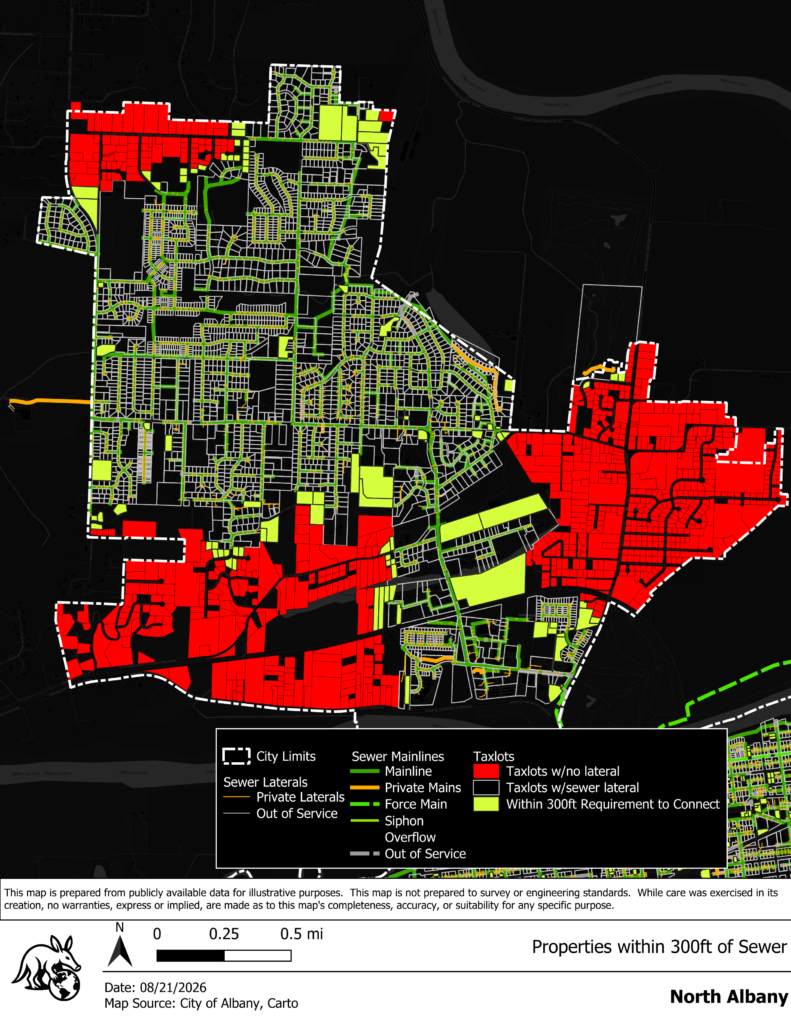
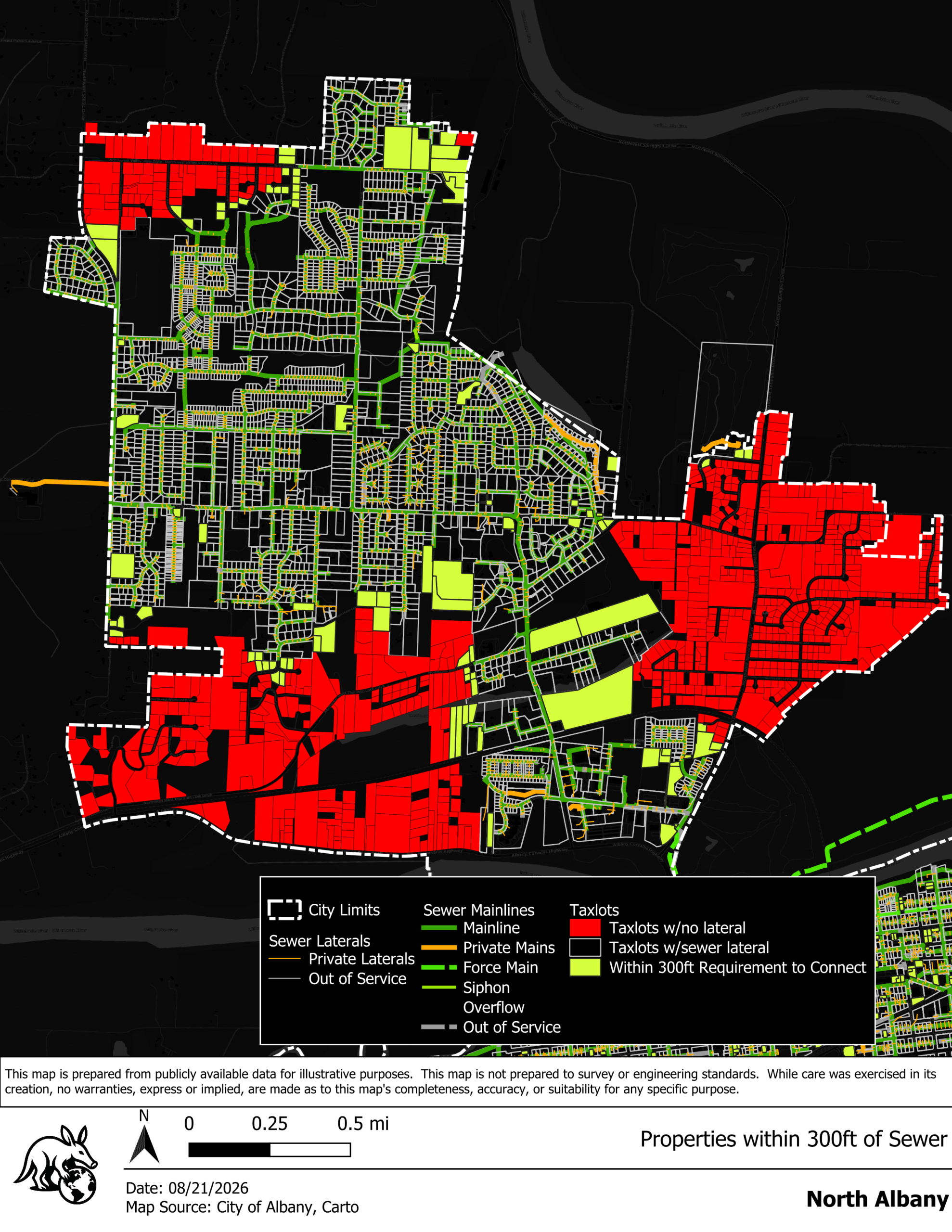
Applying a 300-foot buffer from all city sewer mains, we can determine which parcels would be required to connect in the event of a septic failure or additional development. There’s some, but it’s far from even a majority. I’ve chosen to focus this discussion on North Albany, because while there are some developed, unserved properties in the Linn County portion of Albany, there are not the same types of large, multi-property un-served areas that exist on the Benton County side of the river.
This is where it’s necessary to introduce Albany’s “to-and-through” policy for sewer connection. Not only are property owners required to connect to city sewer if they are within 300 feet of the system, they are required to extend the main to which they want to connect along the full street frontage of their property. This puts the main that much closer to the next property down the street, and brings additional land within that 300-foot connection requirement. This sounds great in theory, and is what requires developers putting new homes and buildings in to construct sewer mains along such properties to serve the new buildings, but sewer mains aren’t cheap, and this can be a heavy burden to bear for an existing homeowner.
For example, a group of owners along Thornton Lake Drive in North Albany explored the idea of a Local Improvement District to pay for a 1,000 foot sewer extension to serve all of their properties. LIDs are a way for property owners to collectively petition the city to construct improvements, which are then billed to the owners within the LID for their share. The cost estimate ended up being $1.1MM, and the LID idea was abandoned. $1,100/foot was not a price these residents could pay, and the majority of the properties remain on septic to this day. More recent estimates that owners have received to accomplish “to and through” along their frontage have ranged from $200,000-$300,000, far in excess of even the steep cost of a new septic tank.
So what would it take to put these properties in range of connection? Looking at the city’s 2026-2030 Capital Improvement Plan, no new mains other than the two major interceptor projects are planned, so we have to make some educated guesswork. Drawing in new mains along city rights-of-way, we get something like this:
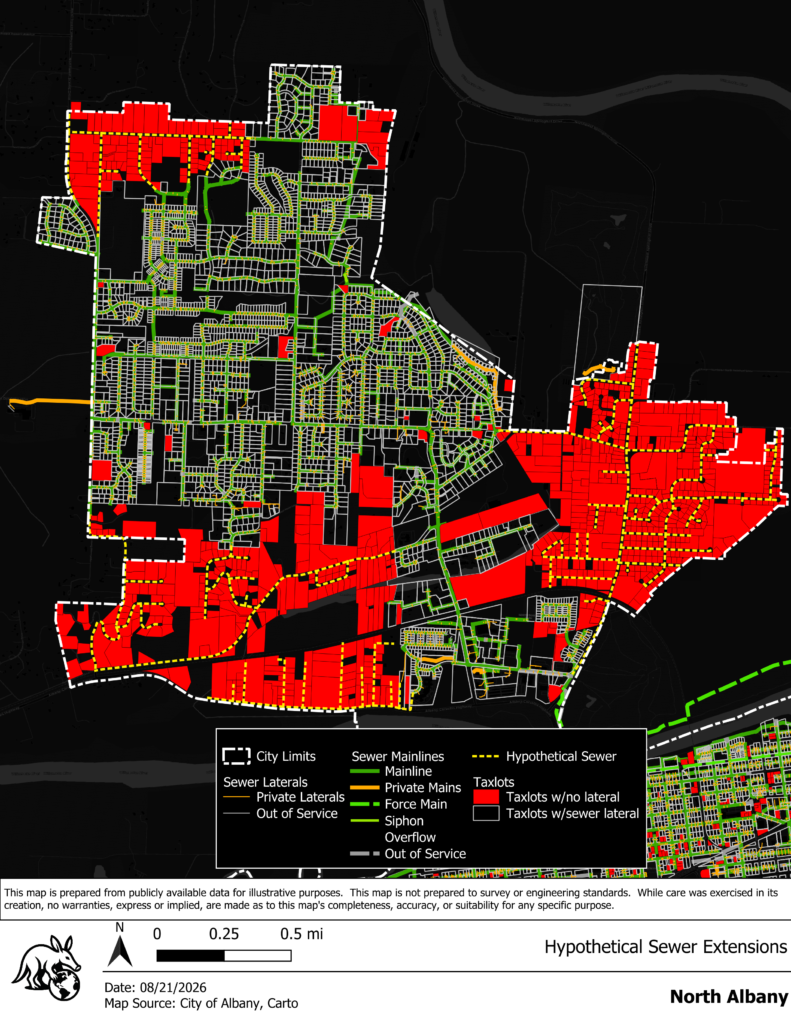
Keep in mind that I am not an engineer – and sewers are highly engineered systems. Most sanitary sewer mains are gravity fed, meaning that the pipe must lead downhill in order to flow. Lift stations and force mains can be used to move pipe contents “against gravity” as it were, but these add to the cost of the system. North Albany’s hilly terrain may make such additions mandatory. Not all of the pathways above may be suitable for a sewer main in practice, and this is meant to be illustrative only.
Measuring linear feet of pipe in the hypothetical layer, we get nearly 70,000 additional feet of sewer main. All told, at the same estimate of about $1,100/foot that the Thornton Lake Drive residents received, that would be a steep $77MM price tag indeed, and could not happen overnight.
At the same time, is it fair to ask individual property owners to foot this bill piecemeal as they are required to connect? These are not new developments in these areas, but existing residents facing unanticipated costs far steeper than they would have been when the properties were annexed in the 1990s. It is also likely that construction could be far more efficient completed in large, planned segments at the behest of the city versus in small, “required only” segments for individual property owners. It’s not going to be cheap as a capital project either, but that may be the better way.