
In the previous post, grocery retailer behavior was examined in Corvallis, Springfield, Salem, and Eugene, all of which pointed to Albany being treated differently than similar communities in that, on average, one would expect to see one Safeway or Albertsons store per about 21,000 residents, while Albany has only one for almost 60,000 residents. When coupled with the fact that Albany lacks anything close to the diversity of small-format grocery retailers found in similar communities, leads to the conclusion that Albany is underserved in the grocery market at its current population, which contributes to Albany’s low walkability.
Population Dynamics
In order to examine plausible solutions, it is first useful to examine some population history for Albany and the surrounding region, as well as examine how land is allowed to be used across Albany in the form of the Albany Development Code. As much of the previous analysis has focused on population, historical populations for Albany and the four main comparator communities are provided below by census year from 1900 onward:
| Census | Albany | Corvallis | Lebanon | Springfield | Keizer |
| 1900 | 3,149 | 1,819 | 922 | 353 | |
| 1910 | 4,275 | 4,552 | 1,820 | 1,838 | |
| 1920 | 4,840 | 5,752 | 1,805 | 1,855 | |
| 1930 | 5,325 | 7,585 | 1,851 | 2,364 | |
| 1940 | 5,654 | 8,392 | 2,729 | 3,805 | |
| 1950 | 10,115 | 16,207 | 5,873 | 10,807 | |
| 1960 | 12,926 | 20,669 | 5,858 | 19,616 | 5,288 |
| 1970 | 18,181 | 35,056 | 6,636 | 27,047 | 11,292 |
| 1980 | 26,546 | 40,960 | 10,413 | 41,624 | 18,592 |
| 1990 | 29,462 | 44,757 | 10,950 | 44,683 | 21,884 |
| 2000 | 40,852 | 49,322 | 12,950 | 52,864 | 32,203 |
| 2010 | 50,158 | 54,462 | 15,518 | 59,403 | 36,478 |
| 2020 | 56,472 | 59,922 | 18,447 | 61,851 | 39,376 |
| 2025 (est) | 59,234 | 61,671 | 19,065 | 63,779 | 39,040 |
While Albany began the 20th century as the largest among this set of communities, growth was not evenly distributed, and by 1920, Corvallis had overtaken Albany as the largest among the comparators, likely in large part to the presence of the Oregon Agricultural College (later Oregon State University). Growth in the post-WWII era also pushed Springfield’s population beyond Albany’s by 1950, and by 1970, both Corvallis and Springfield exceeded Albany’s population by at least approximately 10,000 residents. This trend continued until about 2010 when Albany began to experience a period of more rapid growth, while growth in Corvallis and Springfield slowed. Visualized, the four communities’ populations looks like:
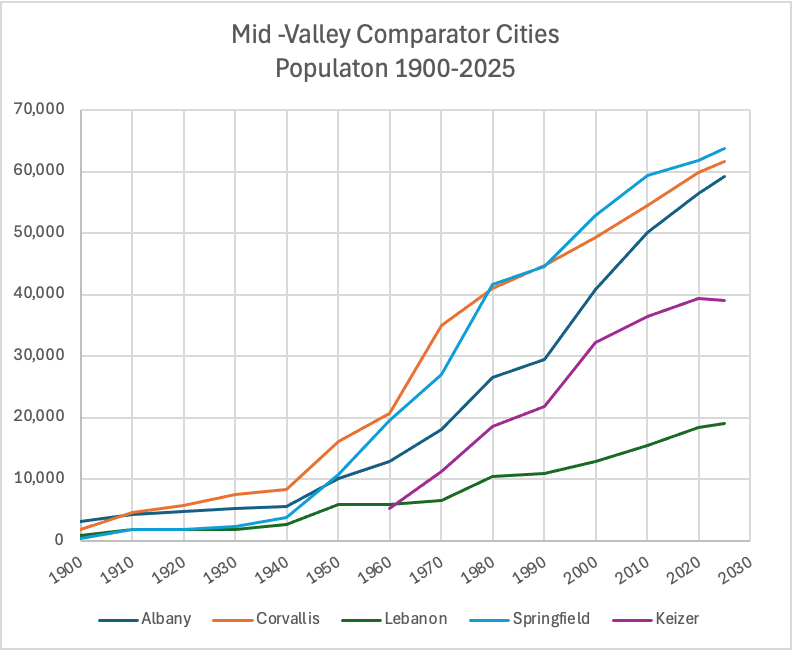
From about 1960 until about 2010, the gap between Corvallis (orange) and Springfield (light blue) versus Albany (dark blue) is much more significant, narrowing in the 2010s and into 2025 where the last population estimate is available. Keizer experienced growth similar to Albany from the 1960s through the dawn of the 21st century before its growth levels off, and Lebanon has consistently been a smaller community with a slower but steady rate of growth.
The above serves to illustrate that cities are not static objects, and process philosophy would encourage us to view these communities as dynamic over time, shaped by the social and geographic forces that they interact with. In short, we cannot simply say “this community is this size, therefore it should behave like X.”
When a community reaches a particular size or geographic extent is just as important as the fact that it has done so. How grocery stores functioned and the market for the same looked sharply different in 1980 when Corvallis crossed the 40,000 resident threshold, for example, versus in 2000 when Albany did the same, and even more so in 2025 when the last available population figures are estimated. In 2022, the US Bureau of Labor & Statistics’ American Time Use Survey revealed that at least 19% of respondents had purchased groceries online within the last 30 days for either delivery or pickup. All indications are that this number has grown since 2022, not fallen, with delivery taking larger shares than pickup orders in recent years. Albany’s more recent rapid growth comes at a time when grocery retailers may be more reluctant to open additional brick-and-mortar locations due to shifts in consumer behavior toward online fulfillment versus in-store shopping. Grocery retailers are also facing economic pressure to close underperforming stores, with both Albertsons Companies, Inc. and Kroger, featured in earlier analysis, highlighted for doing so. Grocery markets have also shifted sharply toward larger retailers and regional/national chains, with independent grocery stores only accounting for about 22% of the overall market as of 2017.
Considering the above, one might wonder if attracting additional grocery stores to Albany is a lost cause, but it is worth noting that even in light of the above challenges in the overall grocery market, other comparable communities have not experienced a market correction resulting in a level of store closures leaving them with a similar level of grocery access to Albany. While changes to the overall market may make the exact same number of access points harder to achieve as communities that reached higher populations earlier, it would still be remiss of Albany to accept the current level of access as “the best that can be done.”
Since such a market correction has not happened in similar communities, we must conclude that it is not impossible for a collectively greater number of stores to operate profitably in a city of Albany’s size.
Contraction of Access in Albany
If a city is a process rather than a static object as discussed above, it is therefore natural for business of any type to ebb and flow, with retailers moving in and out of the community and changing locations. Within recent history, we can map changes in grocery access in Albany, with two former stores highlighted below:
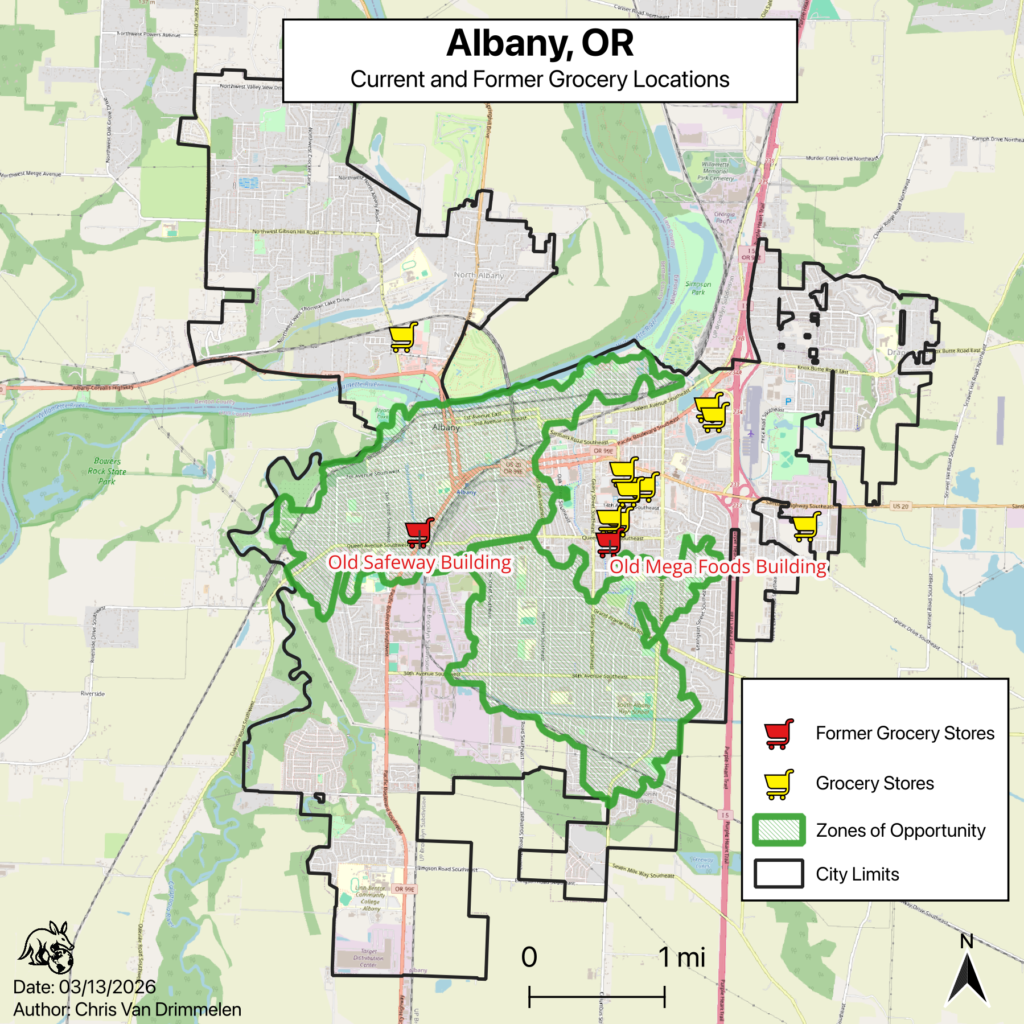
The above map shows two former grocery store locations with the previously discussed “zones of opportunity” where only grocery access must be added within reasonable walking distance in order to escalate an area to the highest level of walkability. While it is useful to note the closure of the Albany Mega Foods in 2021, its location did not significantly contribute to walkability or access to groceries based on close proximity to other grocery stores.
The closure of the former Safeway in West Albany in favor of a move to its current location, however, paints a sharply different picture. Safeway moved from its old, approximately 30,000 facility in 1999, when Albany’s population sat at about 40,000. This removed walkable, and indeed otherwise proximate access apart from those who may have chosen to walk, from the entire West side of the city (the North Albany Village shopping center and its anchor grocery store did not exist at this time). While 40,000 would be a statistically low bound for a city to merit a second Safeway store based on prior analysis, the pace of growth experienced by Albany in the decade prior does make the decision to move rather than open a second location appear shortsighted.
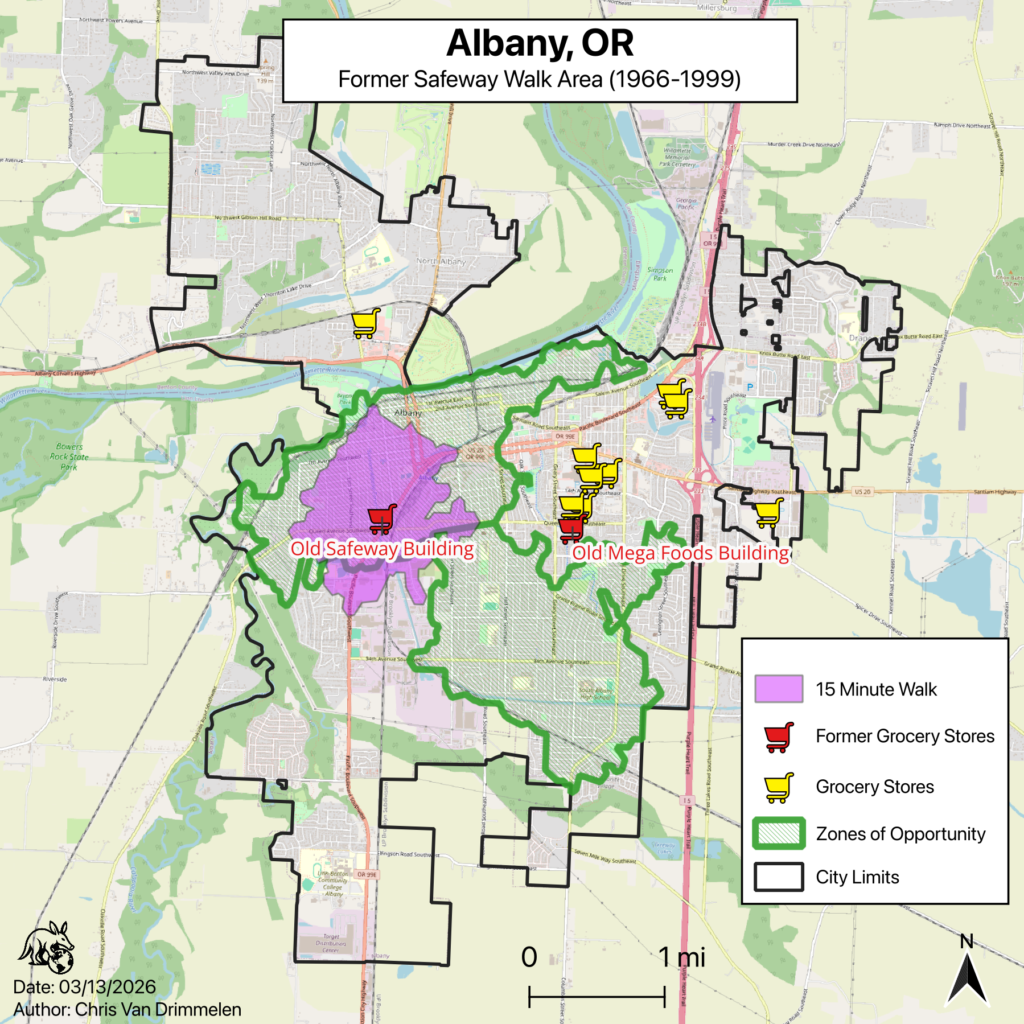
Overlaying a 15 minute walk area around the old Safeway building shows that a significant portion of the Central Albany Zone of Opportunity would remain at the highest level of walkability if this location continued to operate as a grocery store. It appears that even Safeway and its parent company wanted to keep that option open until at least 2016 by maintaining their lease on the shuttered building. As of this writing, the building’s re-use as a grocery store is unlikely, despite its ideal location, as it is being prepared for new life as the Adult and Teen Challenge Thrift Store’s new home.
While the above reflects more recent shifts in grocery access in Albany, this process has gone on for as long as Albany has existed, with Safeway having originally operated in Downtown in the 1930s-1940s, and the building housing the Pix movie theater in downtown having also been a grocery store in the 1940s. The move away from downtown over time reflects a broader trend in Albany’s population whereby East Albany’s Ward 3 is now the most populous at about 22,528 residents in 2025.
An eastward shift in overall population does not, however, mean that sizable portions of Albany’s population should be left behind in terms of proximate grocery access.
Coming soon: Where would you put another store? And what could the city do to help?