
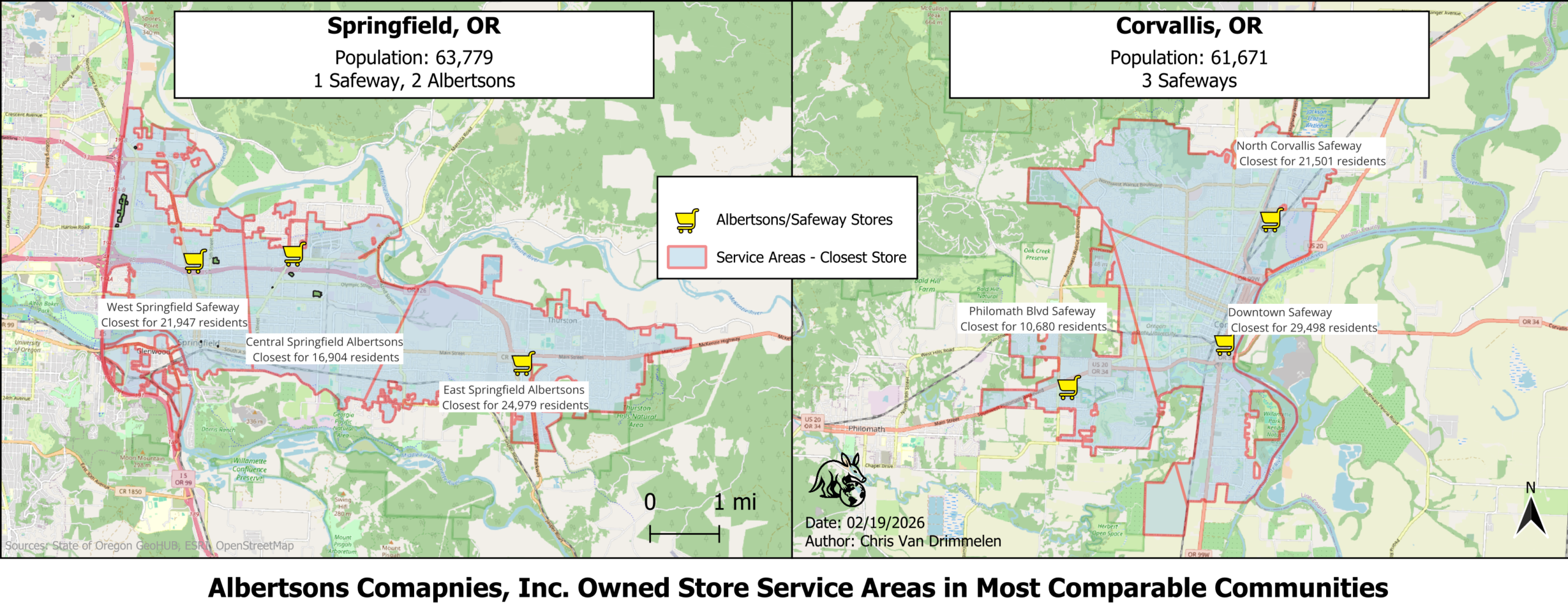
In previous posts, Albany’s walkability was found to be closely tied to the presence of grocery stores, and that Albany fares much worse on this metric than similar communities in the Mid-Willamette Valley. Not only are Albany’s grocery stores clustered in one part of the city to a greater degree than other cities, Albany has a lower overall number of grocery stores than communities with a similar population.
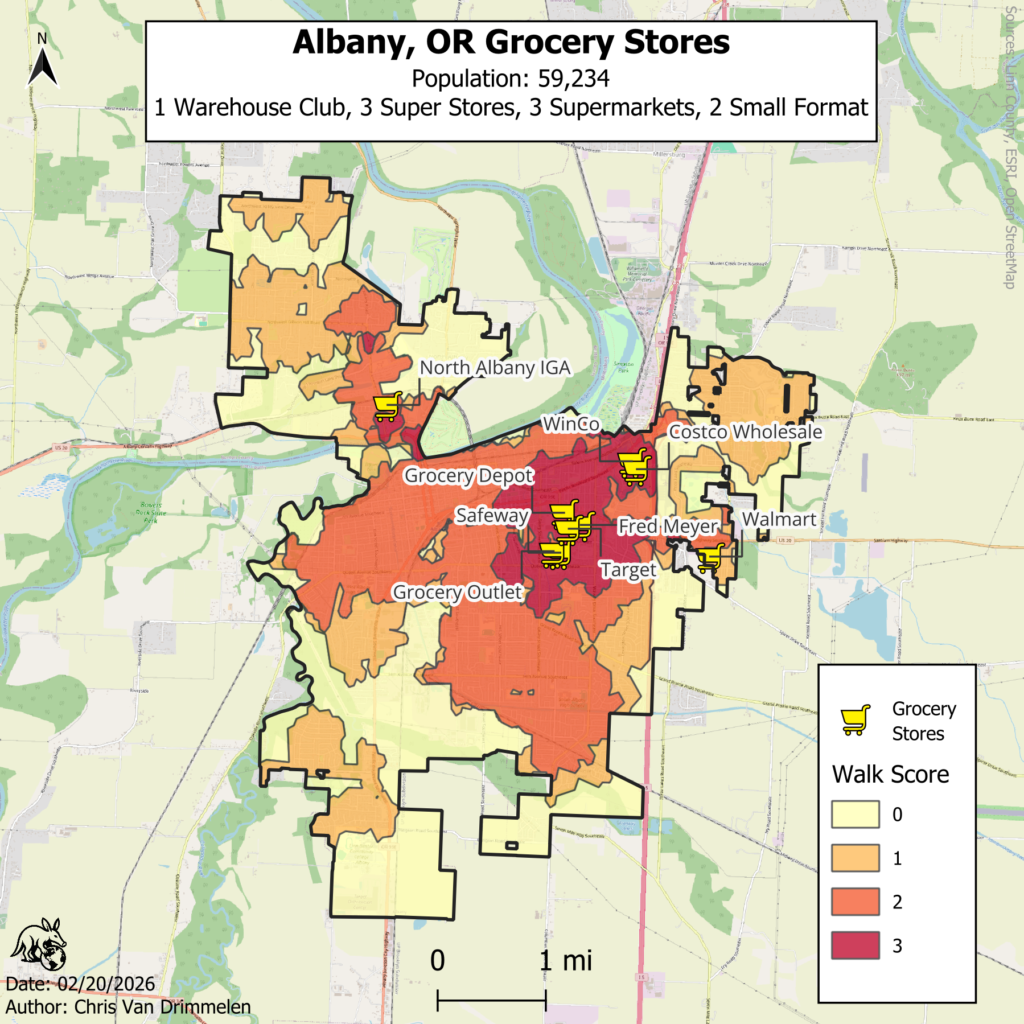
Previously, the discrepancy in the number of small format and specialty stores was highlighted, as the two most comparably sized cities in the valley have, at minimum, double the number of stores in this category as Albany. Such small format stores could go a long way toward altering the walkability landscape in areas of the city that are already established or “built out” as they can provide a vital service in a smaller footprint than traditional supermarkets or super stores, putting healthy food closer to residents and giving consumers a greater number of options – small format stores would generally not replace larger grocery retailers, but might add healthy competition to the market.
At the same time, an inventory of grocery stores also reveals inconsistent behavior among larger retailers in Albany versus comparator cities, particularly in the traditional supermarket segment. Albany’s super stores (Fred Meyer, Wal-Mart, Target) track with the fact that there are one each of these retailers in both Corvallis and Springfield (Springfield’s Wal-Mart Neighborhood Market falls into the traditional supermarket category, and the decision to located this store may be affected by the presence of Eugene directly across I-5). Among traditional supermarkets, IGA does not operate any other stores in this area, and WinCo operates one store each in Corvallis and Springfield.
The major anomaly in the Albany market is Boise, ID based Albertsons Companies, Inc., which operates both the Safeway and Albertsons brands within this region. Albany has had one Safeway location since 1966, originally located on Pacific Boulevard near West Albany, then moving to its larger, current location in 1999. At the same time, Corvallis has three Safeway brand stores, and Springfield has one Safeway and two Albertsons stores. This means that, in practice, given the other market similarities, the single Safeway in Albany is expected to serve all of the nearly 60,000 residents of the city (plus at least nominally the 3,000+ residents in Millersburg to the north), while the stores in Corvallis and Springfield could be said to primarily serve only a portion of the overall geographic area or population of the city in question.
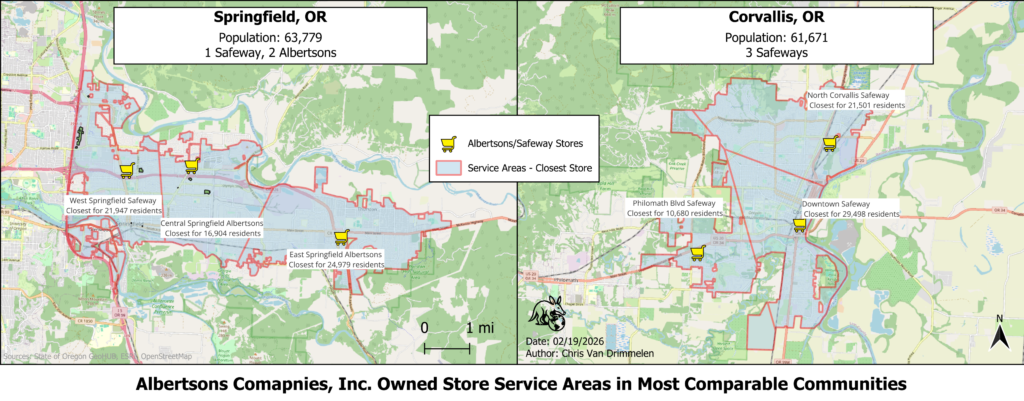
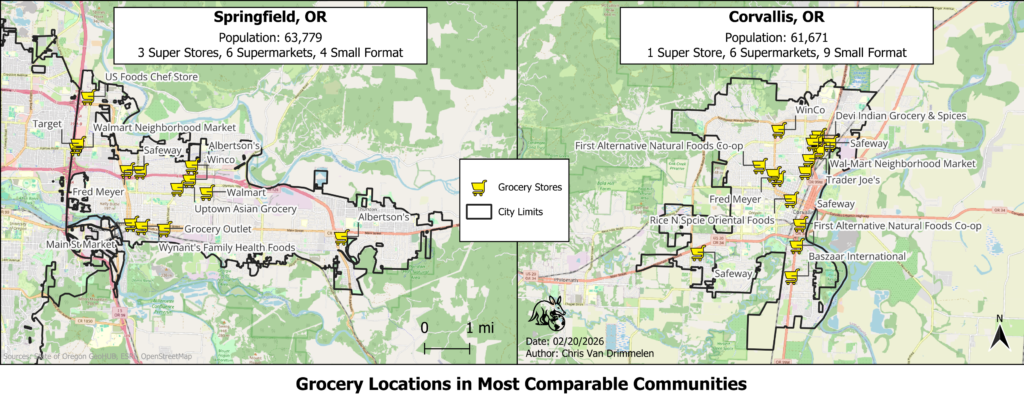
To examine this distribution of Safeway/Albertsons’ overall customer base, Thiessen polygons have been generated denoting the area of the city physically closest to each store. These polygons divide up the overall geographic area using simple distance and approximate the “service area” for each store owned by the same parent company, and have had population data apportioned to each in the same manner as has been done previously for other areas such as those in the earlier walk score analysis.
Overall, a general pattern can be seen, with a population served ranging from 10,680 residents closest to the store in question to a high point of 29,498 residents. Averaging across all six Safeway/Albertsons stores in the above map, the average population served per store is about 21,918, well below the total population of Albany. It is worth noting that these are also likely low numbers given that the population apportionment is confined to residents within the city limits of each community. In reality, there are plenty of individuals who live outside of the city limits of each who would still find these stores to be within a convenient distance, particularly on the west end of Corvallis near the Philomath Boulevard Safeway, which otherwise has the lowest apportioned population in its service area.
It should also be noted that, while it does not directly border Corvallis in the way that communities like Albany/Millersburg, Salem/Keizer, and even Eugene/Springfield function, the city of Philomath, with a 2025 estimated population of 5,776 lies only a few miles down the highway from the aptly named Philomath Boulevard Safeway. Taking both proximity and the fact that Philomath lacks a grocery store of its own following the closure of its Ray’s Market in 2014, the population served by this store quickly ceases to look like a low-outlier.
Returning to a map from an earlier post, it may also be instructive to examine the behavior of this particular retailer in smaller communities to establish a predicted “floor” for the smallest populations that they attempt to serve:
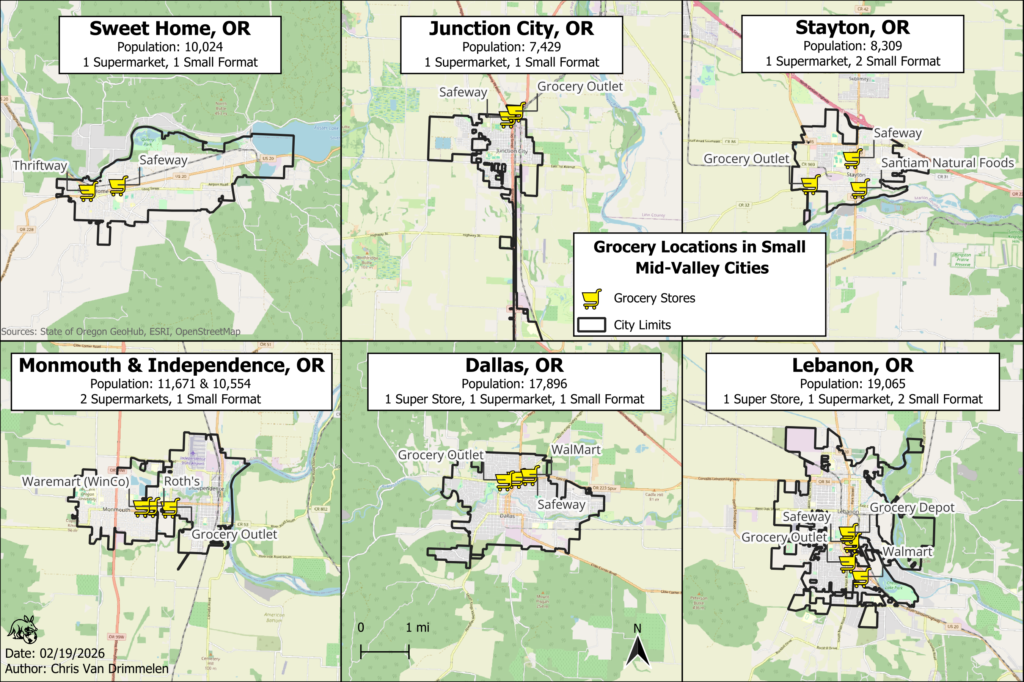
A quick re-examination of the above seems to indicate that the Safeway brand is common in smaller communities of 7,000 or greater in the mid-valley, with 5 of the 6 communities above hosting a Safeway store. The example of Lebanon above is particularly instructive as this community of about 19,000 still only has one store of this brand, and is well in line with the average number of customers served per store in Corvallis and Springfield.
While the above maps and data begin to paint a picture, the significance of the initial conclusions should not be overstated with only two comparator communities. As previously mentioned, cities in a population “middle space” are somewhat hard to come by in Oregon writ large. While the direct comparator group is relatively small, it may be informative to examine grocery retailer behavior in larger communities to see if the pattern holds.
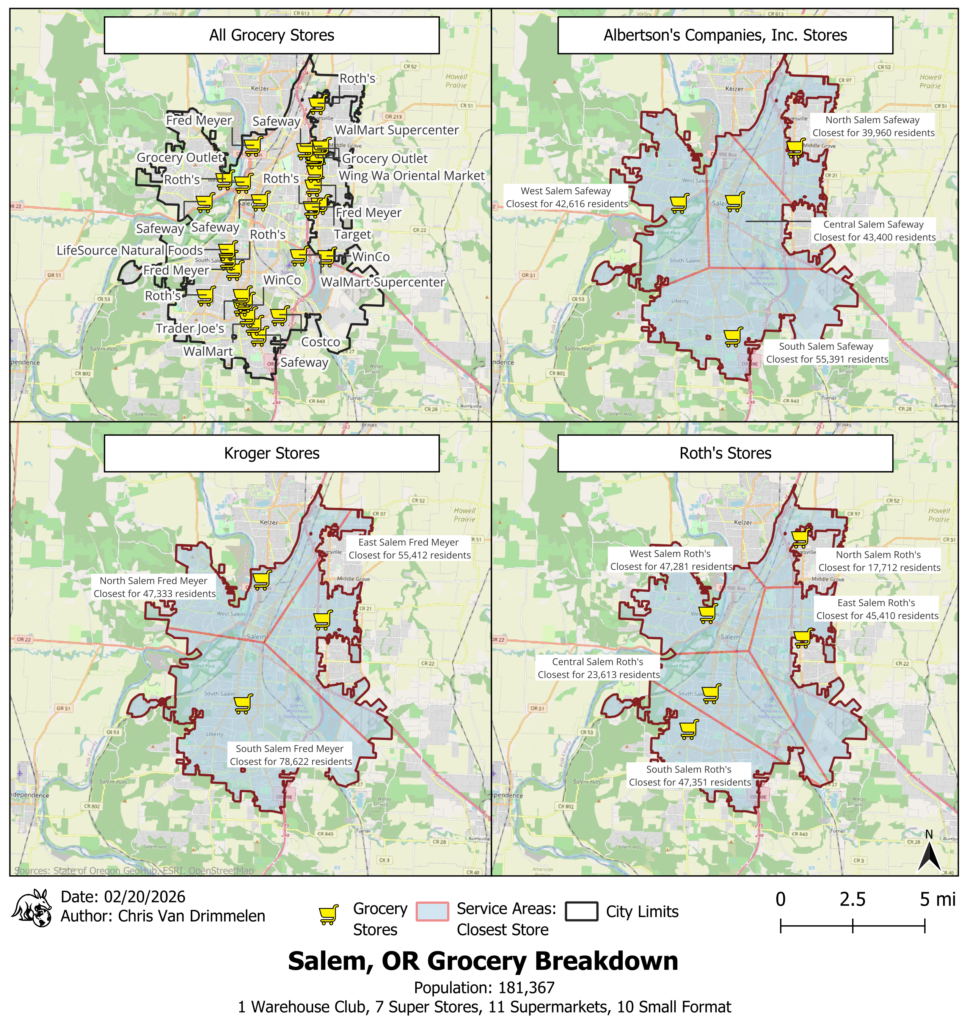
In the series of maps above, we see that Salem, a much larger city of over 180,000 residents, has a commensurately much larger pool of grocery stores than cities like Albany, Corvallis, or Springfield, with 29 grocery stores in total.
A similar Thiessen service-area breakdown of Albertsons Companies Inc.’s portfolio in Salem (all Safeway stores) reveals four stores, each with a population served higher than one might expect based solely on the Corvallis/Springfield data, but none of which has a service area population the size of the total population of Albany, with or without the addition of Millersburg. Average residents within each store’s service area for Salem Safeways is about 45,341.
Larger communities also afford the opportunity to examine other retailers, such as Fred Meyer, owned by Kroger, which do not operate multiple stores in any of the heretofore examined cities. A division of the city of Salem into which areas fall closest to each of its three Fred Meyer stores shows between 47,333 and 78,622 residents served by each store, indicating that Albany is not in the population class that would attract a second Fred Meyer store. It is also worth noting that while the North Salem Fred Meyer has the lowest population served based on Salem population apportionment alone, it sits near the border with Keizer, a community of about 40,000, effectively making it the “Keizer Fred Meyer” as well, with a population served over 80,000, more in line with South Salem’s store.
The regional grocery chain Roth’s Fresh Markets, founded in Silverton in 1962, which operates five stores in Salem, is included above with a similar service area breakdown for comparison. Roth’s was acquired by Canadian supermarket conglomerate The Pattinson Food Group in 2021 following the retirement of the chain’s longtime CEO, Michael Roth, son of founder Orville Roth. Roth’s appears to serve, on average, about 36,273 residents per store by proximity. Roth’s does not currently operate directly adjacent to Albany, but operates stores as far from their Salem distribution center as Silverton and McMinnville.
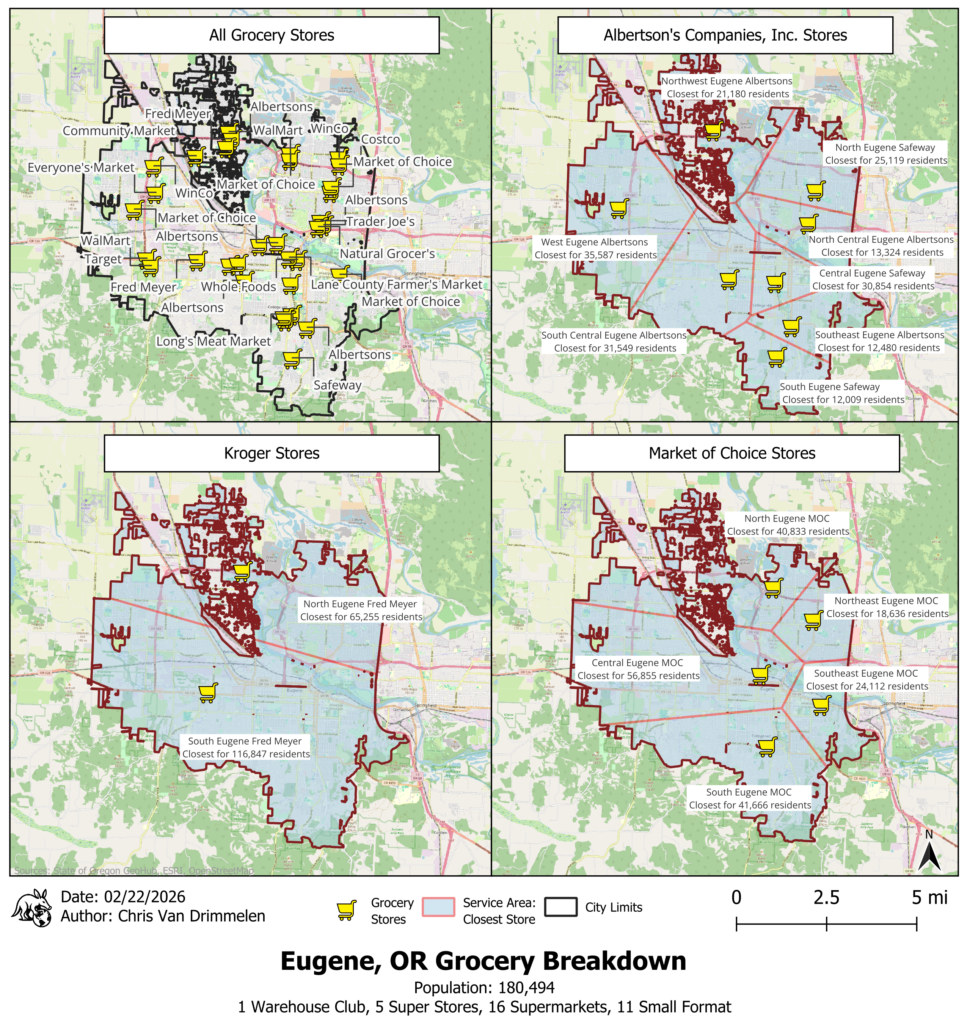
Applying the same methodology to Eugene, another city of about 180,000, we see 33 grocery stores in operation, which is roughly similar to Salem.
Examining Albertsons/Safeway operations in Eugene shows 8 stores, putting service area populations by proximity much closer to what we see in Corvallis and Springfield. Each store ranges from having 12,480 residents physically closest to a high point of 35,587 residents within service area. On average, each store serves about 22,762 residents.
Fred Meyer’s breakdown in Eugene is much more binary as there are only two Fred Meyer stores in the city, each serving at least 65,000 residents by proximity. The lack of a third Fred Meyer in Eugene is likely explained by the fact that Springfield has its own Fred Meyer, further cementing the notion that Fred Meyer only tends to operate multiple locations in much larger cities.
Much like the regional chain Roth’s was included for Salem, the Eugene based Market of Choice is included as a more local comparator for Eugene, operating 5 stores in the city ranging from 18,636 residents served by proximity, to 56,855 residents on the high end. The average served by each store is approximately 36,420 residents. Market of Choice already has a presence near Albany, with one store in Corvallis.
All of the above serves to indicate that Albany is, in fact, underserved by grocery retailers for a city of its size. While Albany is not of a size to merit multiple stores from some of the larger retailers who operate in Oregon’s Mid-Willamette Valley, there are clearly retailers, most notably Albertsons Companies Inc. who would typically operate at least a second, if not a third store in a community of about 60,000, but who choose not to in Albany’s case. The data would suggest that Albany could, at its current population and any new growth notwithstanding, support additional stores if placed in strategic locations. If “the usual players” do not recognize this opportunity, it could be that there is room for other retailers to successfully move into Albany’s market as well.
Coming Soon: How did this happen? And what might be done to fix it?